TikTok vs Instagram: Which Platform Compresses Video Quality More?
Ready to download now? Use the TikTok Video Downloader.
Introduction
Post the same clip to TikTok and Instagram Reels and one version often looks noticeably sharper. That is not placebo, both platforms run aggressive compression pipelines, but they optimize for different priorities. TikTok prioritizes fast startup and adaptive streaming across variable mobile networks. Instagram prioritizes feed consistency and cross-surface delivery across Reels, Stories, and the main grid. Those different goals produce different artifacts, especially on fast-motion content.
If you download video from either platform, understanding compression behavior helps you pick the better source and avoid quality traps like re-sharing across apps.
How TikTok Compresses Video
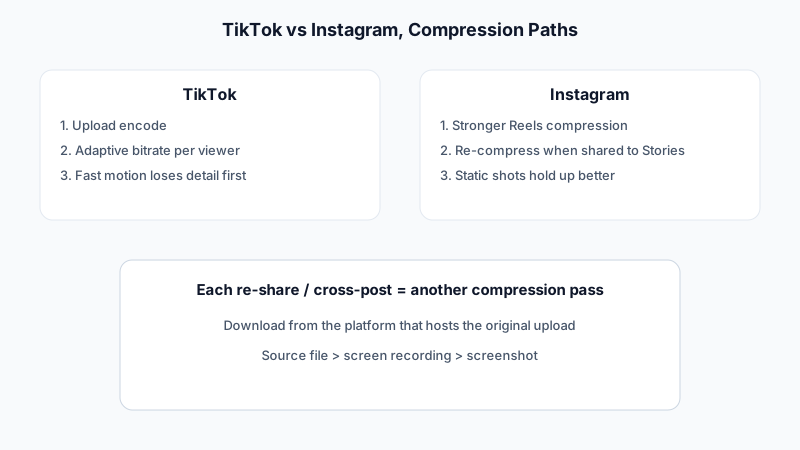
TikTok transcodes every upload into multiple bitrate ladders immediately. When you watch in-app, the player swaps between tiers based on connection speed, you might see 1080p on Wi-Fi and 540p on a weak signal. Fast motion, dance transitions, sports highlights, quick cuts, challenges inter-frame compression. TikTok's codec drops detail in high-motion regions first, which is why choreography clips sometimes look smeared compared to talking-head videos.
TikTok also re-processes audio separately, often normalizing loudness. For downloaders, the key point is that TikTok retains a highest-tier CDN file even if your playback session used a lower stream.
How Instagram Compresses Video
Instagram applies heavier compression to Reels than to traditional feed video in many cases, because Reels compete for bandwidth with Stories, ads, and image posts on the same CDN. A Reel shared to Stories gets compressed again for the Stories format, double compression in one workflow. Slow or static content survives well; rapid camera movement and fine text overlays degrade faster.
Instagram's display pipeline also normalizes aspect ratios and frame rates, which can subtly soften edges when your original does not match their preferred 9:16 spec.
Compression Comparison
Neither platform preserves 100% of your original upload. The question is where each one trades quality away. Use the table below as a practical reference when deciding which platform's file to download or which upload path to treat as canonical.
| Factor | TikTok | |
|---|---|---|
| Upload compression | Aggressive multi-bitrate transcode; retains top CDN tier for download | Strong Reels transcode; feed vs Reels tiers differ |
| Re-share penalty | Moderate when duetting or stitching; original upload stays cleanest | High, Reels shared to Stories get a second full compression pass |
| Motion sensitivity | Fast motion loses detail first (dance, sports, transitions) | Fast motion also suffers; static talking-head Reels hold up better |
Which Source Should You Download
Always download from the platform where the creator originally uploaded, not a cross-posted copy. A TikTok re-uploaded to Instagram Reels has been compressed twice. If the same content exists natively on both platforms, compare the highest-tier downloads side by side; talking-head clips often favor Instagram, high-motion clips sometimes favor TikTok's top CDN tier, but results vary by upload settings.
ReelHox pulls the original source file from each platform's CDN rather than a re-shared or screen-captured copy, so you start from the best available tier either way.
Practical Takeaway
For archival or repurposing, save from the native upload platform as soon as possible after posting, before re-shares and duets multiply compression. If you only care about one save, pick the platform that hosted the first upload. For motion-heavy content, preview both downloads before committing. Compression is invisible in thumbnails but obvious at full screen.
Creators cross-posting to both platforms should treat the first upload as canonical and download from that source. Editors assembling compilations should avoid pulling clips that have already been duetted, stitched, or screen-recorded, each hop adds generation loss. When quality disputes arise, the answer is almost always which compression pass count, not which downloader brand.
Download Strategy Summary
Use a downloader that fetches the top CDN tier without re-encoding. Compare file sizes between platforms when both native uploads exist. Prioritize original upload sources over reposts. For talking-head content, either platform may suffice; for dance and sports clips, inspect both downloads at full resolution before choosing. ReelHox surfaces the highest available file from each platform without adding another compression pass.
Try It Yourself
ReelHox pulls the original source file from both TikTok and Instagram, not a re-shared or re-compressed copy.
Open ReelHox DownloaderFrequently Asked Questions
Which platform has better video quality overall?
It depends on content type and upload path. Neither is universally better, TikTok's top CDN tier is strong for native uploads, while Instagram penalizes Reels re-shared to Stories heavily.
Does downloading avoid compression?
You get the best file the platform stores, but that file was already compressed at upload. Downloading avoids additional re-share compression.
Why does my cross-posted Reel look worse on Instagram?
Instagram re-encodes imported video for Reels format. Starting from a TikTok export means stacking TikTok compression plus Instagram compression.
Can I download the uncompressed original?
No platform serves truly lossless originals to viewers. Downloaders retrieve the highest public CDN tier available.